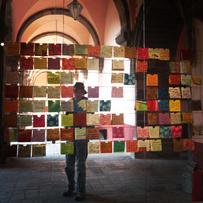
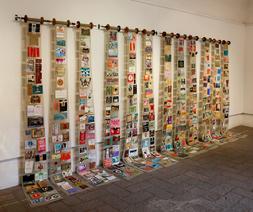
MATRIX installed at Bellas Artes El Nigromante, San Miguel de Allende
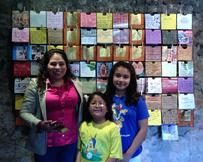
MATRIX installed at Casa Santo Domingo, Antigua, Guate. 2014
MATRIX
Exhibition:
HILOS, Centro Cultural El Nigromante, San Miguel de Allende, Gto, Mx. 2016
A tribute to the mother via this matrix, which is best described as ‘something in which something else develops or forms.’ Also described as ‘something shaped like a pattern of lines and spaces.’ You are invited to remove a paper huipil from this grid, and with a marker, write a tribute, letter, or poem to a mother or any feminine persona who has helped you to develop into who you are today. That may be a teacher, a mentor, a goddess, a legend or myth: a spirtual matriarchal entity you appreciate or embody, or wish to embody.
365 4 2015
365 4 2015
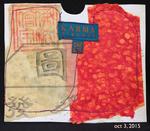
The title signifies 365 huipiles for the year 2015. On January1, I made a commitment to create a huipil a day as a way to witness my own process as I worked toward the completion of this exhibition. The medium, size and concept would vary, as our lives always do, depending on where we are on any given day, in our lives or in our minds. It was sometimes difficult, sometimes pleasurable; to continue making work no matter what else was going on.
El título significa 365 huipiles durante el año 2015. El 1 enero, hice un compromiso de crear un huipil diariamente como una manera de ser testigo de mi propio proceso mientras trabajaba para llevar a cabo esta exhibición. La técnica, el tamaño y el concepto variarían, como nuestra vida siempre lo hace, dependiendo de dónde estemos en un determinado día, en nuestra vida o en nuestra mente. Algunas veces fue difícil, algunas veces placentero; para seguir creando arte no importa qué más estaba ocurriendo.
Image:
COMO AGUA DE MAYO Galeria 6, Mineral de Pozos, March, 2013
The Pathmaker huipil was beautiful before the installation, I almost believed it was enough, but given its own room and some props, it became more of perhaps what it wanted to be all along. The tree planted on the viewer's left side creates a space to mentally enter into, to contemplate the safety, or the wisdom, of walking beneath those branches, into whatever may lie beyond. The lone figure is reading a quote written on the wall:
"You enter the forest at the darkest point, where there is no path.
Where there is a way or a path, it is someone else's path. You are not on your own path." -Joseph Campbell, The Hero's Journey
A tumbleweed, an old suitcase covered in dry leaves and a large hat offering shade from a harsh sun propose the possibility of a long sojourn.
Maps of the world, maps of Mexico, it doesn't matter - they're all upside down anyway. You have no need for them, make your own path! "Let each man take the path according to his own capacity, understanding and temperament. His true guru will meet him along that path." -Sivananda Saraswat
Inside the Pathmaker's pocket is a loose leaf book of "Things Collected Along the Path." Because surely, if you take the path, you will be gifted with treasures that will remain in your heart and your mind for all of your life. "When the path ignites a soul, there's no remaining in place. The foot touches the ground, but not for long.' - Hakim Sanai
EL SILENCIO / A TRIBUTE TO SOR JUANA INES DE LA CRUZ On International Women’s Day, March 8, 2008, an art installation opened at El Museo de la Ciudad in Queretaro, featuring a garment in honor of the first woman to argue for women’s rights on this continent. Sor Juana Inés de la Cruz, the 17th century poet nun, is honored in this two-part exhibition. The origin of Women’s Day was a march for women’s rights on March 8, 1857, the first in the U.S., and was led by women working in the garment industry in New York. Fifty-one years later, a new generation in the industry marched again, demanding better working conditions. That was in 1908, exactly one hundred years ago. I have humbly borrowed the shape of a huipil, the traditional Mexican blouse, to represent women whose stories have been covered up, women who have been silenced, maligned or suppressed. A garment that ‘covers up’ important parts of a woman’s body, the huipil as I revision it aims to expose, rather than conceal, important parts of a woman’s story. Known as Mexico’s Tenth Muse, and the Phoenix of Mexico, Juana was a nun, poet, philosopher, playwright, mathematician, musician, scientist, feminist, in fact, the first feminist in the New World. Silenced by the Church in the 17th century, during the Spanish Inquisition, Juana and her story were largely forgotten until the early 20th century, and thus have been added to my personal pantheon of denied women. (Las Negadas) “SILENCE,” the first part of this exhibition, is an installation intended to restore Juana to our consciousness, through the legacy of her misfortune: her cell as it might have been after her renunciation. Absent are her abundance of books and maps, her scientific and musical instruments, her conch shell and mirror, opulent gifts of art, jewels and furnishings, stacks of manuscripts awaiting publication. These luxuries at one time surrounded Juana, later were confiscate, sold or given away; in their place, there is simply an abundance of solitude and austerity. The centerpiece of “SILENCIO” is a suspended huipil, created from a book of her love poems to ‘Lysis’ and ‘Laura,’ monikers for her intimate women friends, perhaps even her lovers. With pages stitched together like a quilt, it recalls a diversity of talents and passions, the secular kind that so antagonized the church hierarchy. Inspired by the renunciation scene in Maria Luisa Bemburg’s film, "Yo, la Peor de Todas," I added a reflection of the huipil below, composed of rose petals. Mimicking the color of the blood with which Juana signed her renunciation, the petals prostrate themselves, asking forgiveness and begging for mercy. On the wall behind, another huipil is created by the illumination of her words, a disembodied Juana becomes her own shadow.
Image:
THIS SERIES OF PHOTO TRANSFER MONOTYPES IS NOW AVAILABLE AT GALERIA6, ON THE PLAZA PRINCIPAL IN MINERAL DE POZOS.